
Water beads can change category, but not their hazard
The same superabsorbent bead can be sold as a toy, vase filler, craft material or gel-blaster ammunition. The seller’s category changes the applicable rules and corrective action; the swallowing and expansion hazard remains.
Published by the FOLO-UP editorial team
What this briefing shows
The same superabsorbent bead can be sold as a toy, vase filler, craft material or gel-blaster ammunition. The seller’s category changes the applicable rules and corrective action; the swallowing and expansion hazard remains.
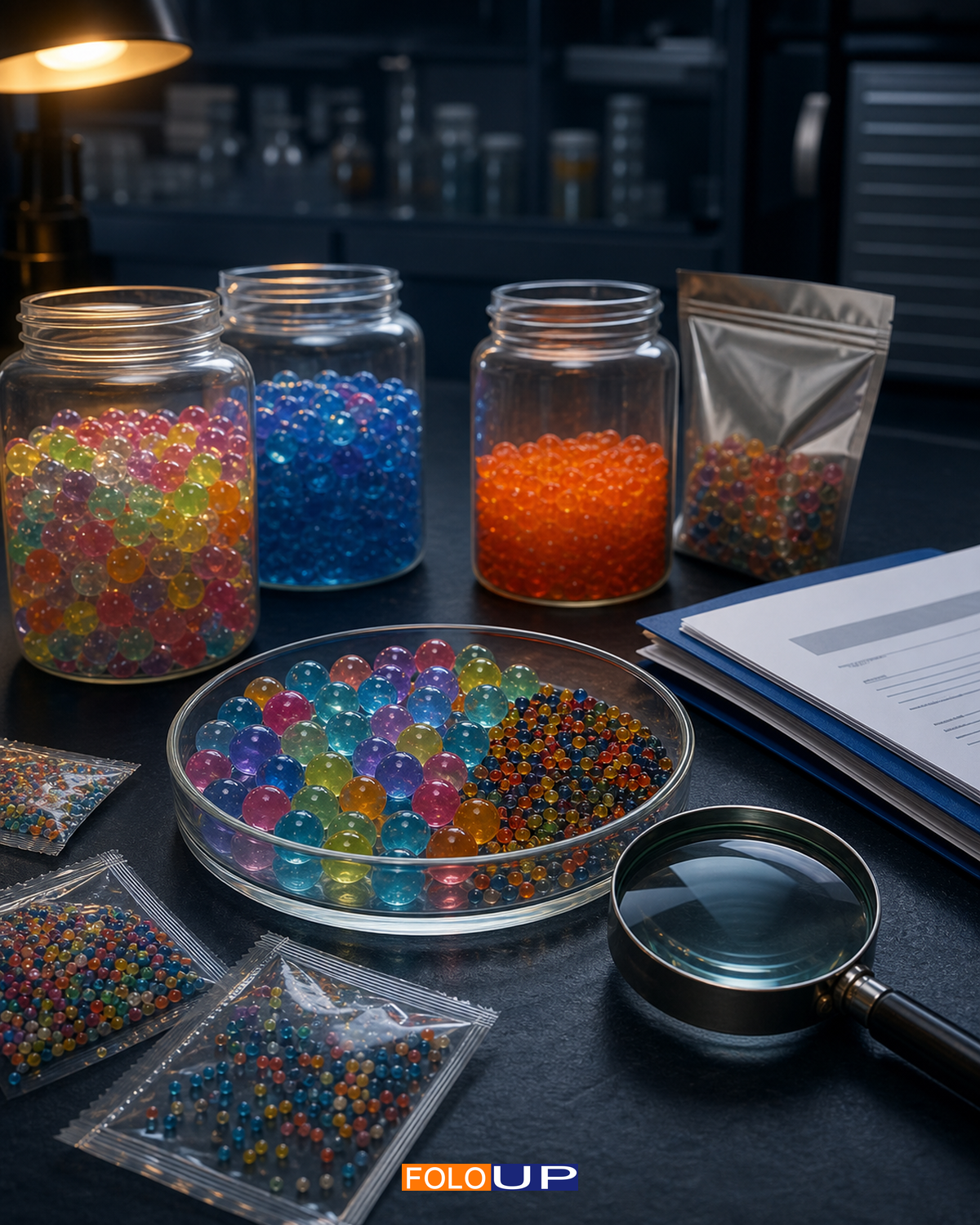
Water beads are small pellets made from superabsorbent polymers. Once immersed, they can grow to more than 400 times their original size. A seller may call them sensory toys, vase fillers, craft supplies, jelly balls, aqua gel or ammunition for a gel blaster, but the physical behaviour does not change when the marketplace category does.
That behaviour is the core child-safety concern. OPSS warns that a swallowed bead may continue expanding inside the body, causing gastrointestinal blockage that can require surgery. The beads can also present choking and asphyxiation risks, may be hard to detect, and do not show on X-rays. The national safety alert links water beads to serious UK harm and child fatalities overseas, advises keeping them away from children under five, and says older children should use them only under close adult supervision.
The newest cluster makes the classification issue unusually clear. On 15 July 2026, OPSS published three serious-risk reports for Amazon listings: Juncture 50,000-piece water beads, Jacisk 200-piece giant water beads, and Jacisk 50,000-piece and 100-piece water beads. All three were recorded as decorative articles, assessed as presenting a serious asphyxiation risk and withdrawn from the market.
Other 2026 notices show that the corrective action can vary even when the underlying material is familiar. A 110,000-piece clear water-bead product sold through Shein was classified as a decorative article and assessed as high risk. The official report records both removal of the listing and a recall from end users, with the notice updated on 15 June 2026.
The same material also appears inside products treated as toys. An automatic electric gel-ball blaster supplied with water beads was assessed under the Toys (Safety) Regulations 2011. By 30 June 2026, OPSS recorded listing removals by DHGate, eBay and OnBuy. This is not merely a wording difference: category, applicable law and corrective action can all change while the expansion and asphyxiation hazard remains.
Product category is legally relevant, but it should not be the only signal used by a marketplace safety system. A control that checks only the seller-selected category may miss the same substance when it is relisted under a different use. Cross-category matching should also examine listing images, material descriptions, pack counts, bead dimensions, expansion claims and terms such as water crystals, jelly balls, vase filler, hydro ammunition and sensory beads.
Platforms should connect reports across those aliases and uses, preserve seller and product identifiers, and test new listings against known hazard patterns. A decorative listing should not escape scrutiny simply because a previous action involved a toy, and a toy listing should not be treated as unrelated to a recall for the same expandable polymer.
For families, the practical message is simpler: keep water beads away from children under five, supervise older children closely, and treat any suspected swallowing as urgent. Follow the product instructions and seek immediate medical advice rather than waiting for symptoms, while telling clinicians that water beads may not appear on an X-ray.
Not every water-bead product has the same legal status, and an official report does not automatically mean every comparable item is illegal. The evidence must distinguish a market withdrawal, a recall from end users and a marketplace listing removal. What the cases collectively expose is a surveillance gap: category labels can divide records that should also be connected by material and hazard.