
The hidden chemical risk in low-cost cosmetics bought online
A cosmetic can look convincing while its ingredients, documentation and responsible supply chain remain invisible. Recent EU and UK evidence puts chemical risk, traceability and online listings at the centre of product-safety enforcement.
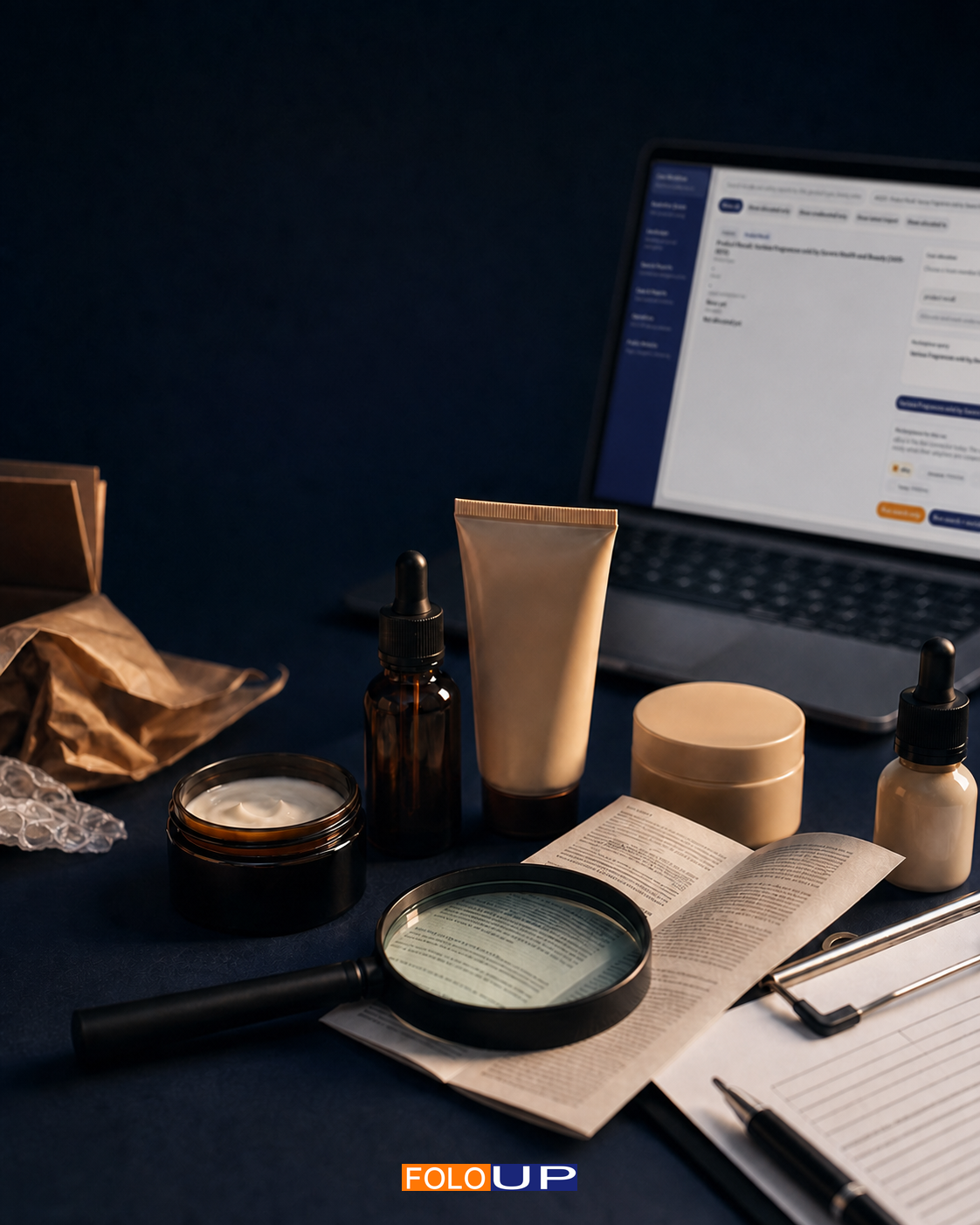
A product photograph can show a colour, a texture and a price. It cannot show whether an ingredient is prohibited, whether the safety file exists, or whether a named business is actually responsible for the product in the country where it is sold.
The European Commission’s 2025 Safety Gate report, published in March 2026, recorded 4,671 alerts. Cosmetics were the most frequently reported category at 36%, while chemical risks accounted for 53% of all alerts. Almost eight in ten cosmetic alerts were linked to BMCHA, a banned synthetic fragrance; authorities also reported nail polish containing TPO, a chemical banned in 2025. The Commission recorded 5,794 follow-up actions, including border stops, withdrawals, listing removals and recalls.
A separate EU customs operation gives the online-shopping problem a more concrete scale. Between October and December 2025, authorities checked 5,772 cosmetics arriving directly from outside the EU and found that 65% did not comply with EU product standards. “Non-compliant” is not a synonym for “proved dangerous”: the findings included missing or incorrect labelling, absent documentation and forbidden ingredients. The operation was targeted, so its result must not be treated as a failure rate for every cosmetic sold online.
The UK’s latest signal is about traceability as much as chemistry. On 17 July 2026, the Office for Product Safety and Standards said 861,686 cosmetic notifications had been submitted to the UK system by 28 May, from 24,112 registered Responsible Persons. OPSS also said it had acted where notifications identified banned chemicals, requiring businesses to correct information or remove products. A notification is a legal step before supply in Great Britain; it is not a public approval mark and it does not replace a safety assessment.
Online marketplaces are part of that chain. Evidence published for the UK Parliament’s beauty-products inquiry says OPSS notified marketplaces about cosmetics containing the banned fragrance Lilial. That evidence led platforms to introduce controls and remove products from supply. Whether a marketplace carries distributor responsibilities depends on the product, seller and supply-chain model, but the enforcement lesson is clear: a listing can disappear only if somebody can identify it, connect it to a responsible business and act quickly.
The latest platform-level warning came on 20 July 2026, when the European Commission fined AliExpress €550 million for failing to assess and mitigate risks linked to illegal, unsafe and counterfeit products under the Digital Services Act. The Commission explicitly included dangerous cosmetics in its account of the problem. The decision is about platform systems, not a finding that every cosmetic listing is unsafe, but it shows why product-safety enforcement increasingly follows the listing and the marketplace as well as the product itself.
The policy direction is moving in the same direction. In June 2026 the European Commission welcomed a provisional Chemicals Omnibus agreement that would simplify parts of the cosmetics rules while strengthening the formatting and legibility of consumer information, including in advertising and online sales. The Parliament and Council still have to approve the agreement before it can enter into force.
For shoppers, the practical check is simple but often awkward: look for an ingredient list, precautions, a batch or identification number, a use-by or period-after-opening date, country of origin where relevant, and a named Responsible Person with a UK or EU address. Missing, minimal or poorly translated information is a reason to pause. Skin-whitening and black-spot products deserve particular caution because UK safety reports have repeatedly found banned substances in those categories.
This briefing distinguishes confirmed chemical findings from paperwork and labelling failures. Both matter: missing information can hide a genuine chemical risk, while a non-compliant listing is not by itself proof that every unit is unsafe. Consumers should stop using a product if they suspect a safety problem and report it through the relevant product-safety service.
At a glance
- Cosmetics accounted for 36% of EU Safety Gate alerts in 2025
- Chemical risks represented 53% of all Safety Gate alerts
- 65% of 5,772 cosmetics checked in an EU customs operation did not comply with EU product standards
- 861,686 UK cosmetic notifications had been submitted by 28 May 2026
- Those UK notifications came from 24,112 registered Responsible Persons
- 20 July 2026: the EU fined AliExpress €550 million over DSA failures involving illegal and unsafe products
FOLO-UP briefing based on the linked official notices, research sources and dated evidence. Claims should be rechecked when circumstances change.