
Five-point-nine billion parcels: why customs cannot inspect its way out of the online product-safety problem
Low-value e-commerce has changed the scale of border enforcement. The EU now receives billions of small consignments each year while the proportion physically controlled continues to fall.
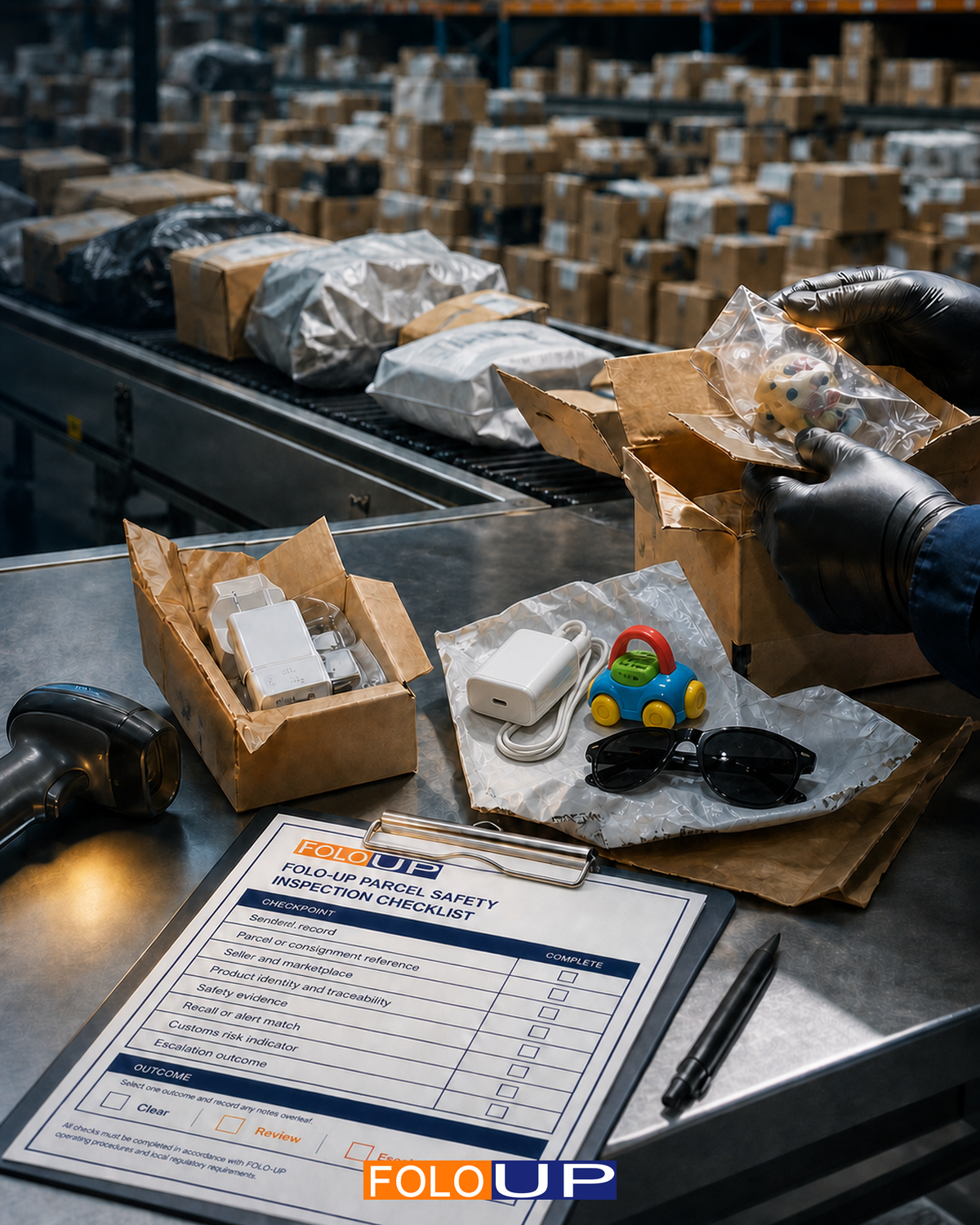
The second phase, from October to December, checked 11,338 pieces: 5,772 cosmetics, 2,092 personal-protective-equipment items and 3,474 food supplements. The Commission reports non-compliance rates of 65%, 60% and 63% respectively. Keep these category findings separate from the toys-and-electronics laboratory sample.
At a glance
- 5.9bn low-value items entered the EU in 2025
- 97%+ of incoming shipments were e-commerce parcels
- 65 customs controls per million imported items
- 387,588 customs controls were recorded in 2025
- 20,040 toys and small electronics were checked in the first 2025 control phase
Editorial Question
When parcel volumes are measured in billions, what can customs controls realistically achieve—and where must product information, marketplace prevention and cross-border intelligence take over?
Why Now
The EU recorded 5.9 billion low-value items in 2025. A temporary €3 customs duty began on 1 July 2026, and product identifiers are due to become mandatory on 1 November 2026. That creates a current policy hook as well as a strong data story.
Proposed Structure
- How a low-value parcel enters Europe.
- Why 387,588 controls still equal only 65 controls per million items.
- What the 2025 coordinated operation found in toys and small electronics.
- The difference between documentary non-compliance and a product confirmed dangerous through testing.
- What happens after customs stops or releases a parcel.
- Whether product identifiers, marketplace data and risk-based targeting can close the gap.
Data Core To Add
The Commission says around 6 billion items were released for free circulation in 2025, while customs recorded 387,588 controls. The resulting control rate was 65 items per million; goods ultimately refused at the border because of non-compliance or serious risk fell below 10 per million. Present these as system-level indicators, not proof that every uncontrolled parcel was unsafe.
What The Targeted Operation Actually Tested
The first 2025 priority-control phase ran from April to June and focused on toys and small electronics. Twenty-seven customs authorities worked with 108 market-surveillance authorities. They checked 20,040 pieces and found 64% non-compliant. A laboratory subset of 659 pieces produced 534 confirmed non-compliant or dangerous results, reported on the Commission page as 81%; the same page also uses an 84% “dangerous” description, so the article must explain that the denominators and labels are different rather than collapsing them into one headline percentage.
What Changes Next
From 1 July 2026, the EU temporary €3 customs duty applies per item in low-value consignments up to €150, not per parcel. Product identifiers can be declared voluntarily from that date and become mandatory on 1 November 2026. A proposed handling fee is a separate measure with its amount and start date still to be determined. The article should explain how identifiers could make risk targeting more useful, while stressing that data quality, seller traceability and post-border market surveillance still matter.
Folo-up Reporting Lens
Follow one parcel through the chain: listing and seller information, electronic customs declaration, risk selection, documentary or laboratory control, border decision, marketplace action and any later consumer remedy. Ask what information is available to a UK consumer when a product is stopped in the EU, and what a marketplace can do before a parcel reaches a border. Use “non-compliant” for missing labels, documents or markings; reserve “dangerous” for the Commission’s laboratory or risk finding.
Accuracy And Reporting Notes
Keep the system-level control rate, the 64% targeted-operation non-compliance finding and the 659-piece laboratory subset separate. Do not extrapolate a targeted control sample to all imports or call every non-compliant item dangerous. The €3 duty is per item, not per parcel, and the handling fee is not yet fixed.
Review Decision
Approve for drafting with the toys-and-small-electronics case study, add the phase-two category box, and seek a customs or market-surveillance comment on how product identifiers will be used in practice.
FOLO-UP briefing based on the linked official notices, research sources and dated evidence. Claims should be rechecked when circumstances change.